
Devotion
“I will bless the LORD at all times; his praise shall continually be in my mouth.
My soul makes its boast in the LORD; let the humble hear and be glad.
O magnify the LORD with me, and let us exalt his name together.
I sought the LORD, and he answered me, and delivered me from all my fears.
Look to him, and be radiant; so your faces shall never be ashamed.
This poor soul cried, and was heard by the LORD, and was saved from every trouble.
The angel of the LORD encamps around those who fear him, and delivers them.
O taste and see that the LORD is good; happy are those who take refuge in him.
O fear the LORD, you his holy ones, for those who fear him have no want.
The young lions suffer want and hunger, but those who seek the LORD lack no good thing.
Come, O children, listen to me; I will teach you the fear of the LORD.”
(Psalm 34:1-11)
Contemplative spirituality is often criticized as being disconnected from reality. People praying in their own silent worlds while everyone in the real world has jobs, bills, families, and other distractions. The logic goes that it is easy to have a strong faith if all you do is pray every day, whereas for those who must contend with reality, such holiness can feel inaccessible.
Psalm 34 provides a counterpoint to such misconceptions. In this psalm we see a faith that is born and tempered in the reality of life. We see the psalmist point back to specific times when God has answered a prayer, when deliverance was granted, and when salvation was experienced. We hear of the angelic protectors encamped around the psalmist in a way that roots them securely to their present, just as they are also rooted in their past.
While we do not have the details of the psalmist’s experiences, the vagueness creates a space for us to insert our own concrete examples: The difficult season where the prayers of others were a needed life raft; the crisis of faith that was navigated by the patience of a wise spiritual companion; or the experience of burnout that forced you to reconnect with disciplines long since neglected. Time and again, our own lives bear witness to the power of God’s presence in both direct and indirect means. When we come to the edge of a new crisis, this history can give us assurance and courage to take the first step knowing that we still are not alone.
While at times it is easier to know God’s presence as believed doctrine than an experienced reality, Psalm 34 invites us to unite our heads and hearts by attending to our lived in bodies. The psalm uses sense language throughout to ground their experience of God. The humble “hear and be glad,” we “look to God” and then we “taste and see that the Lord is good.” Just as a centering breath begins a time of prayer through grounding us in the moment, these senses invite us to slow down and experience God continuously as we move through the world.
The faster and more chaotic life becomes, the easier it is to lose touch with ourselves. How often do we look at the clock and realize that we forgot to eat because we were busy with work or get to the end of the day and realize we have not drunk any water. Losing touch with the basic requirements of life is often a sign that we are becoming disconnected with the spiritual requirements of life as well. Slowing down our pace allows us to notice the beauty of flowers that will be gone in a week. Savoring a meal or snack that would have been rushed through encourages us to be grateful for the hands that prepared it or the people we get to eat it with. Even for those of us who are accustomed to setting aside times to be still in prayer, rushing through the rest of our day limits the multitude of other places God desires to show up.
When are the times during your week you can slow down and be intentionally inefficient. What are the moments you can savor sense the presence of God?
Baking Focus
In my opinion, biscuits are one of the simple joys in life. Breaking open a fresh warm biscuit is an invitation to filling it with either something simple like butter, honey, or jam. However, it also makes an excellent base for a sandwich or even thick gravy. The options are endless. While a can delivers the promise of consistency, the process of making this breakfast staple from scratch is one of my favorite ways to welcome the newly offered grace of the morning.
The process of making biscuits is best done at a steady and brisk pace. If you go too slowly the butter will warm up and melt into your dough leaving you without the delicious flaky texture. If you go too fast, however, the butter will not be incorporated enough and will just melt In the heat of the oven frying your dough and burning in the process. Most early biscuit bakers take too long and don’t trust themselves. I find that my best biscuits come as I am in a slight rush to get other things on the table. As you engage in this contemplative baking exercise try to make mental notes along the way so that as the biscuits are in the oven, the reflection can occur as the dishes are done.
Taste and see
My preferred biscuits use a combination of half butter and half chilled bacon fat. Not only does saving the fat reduce food waste (it has so many other great uses as well!), but the dough gets infused with a subtle smokiness that compliments the rest of the breakfast plate. As the dough comes together, pay attention to the smells of the tangy buttermilk and the smoky/saltiness of the bacon wafting up as everything comes together.
Messy Middle
Psalm 34 includes a prescript that places it within the story of King David, but specifically the time in his life where he pretended to be crazy as a way of avoiding the Philistine King (1 Samuel 21). There is a part of making any bread, after the wet ingredients are added to the dry, when everything looks like a chaotic mess that is never going to come together. This messy middle stage can be intimidating. In making biscuits, this is the time when you scrape the contents of your bowl onto a floured surface and then begin to quickly fold the dough over onto itself rolling it out in-between. As you move through the process, the crazy whisps of dough will come together and soon the biscuit dough will be ready to cut.
Such it is with our lives, the times we look back on where life seemed the most out of control and messy were the moments where we often relied on the steadfast strength of God, the consistent prayers of our friends, and the ingrained habits of our faith to make our way to the other side.
None of us is ever fully baked, however, in the practice of baking, we can be reminded of the presence of God and practice our faithful memory so that when we find ourselves disconnected from God and ourselves, we can trust that God’s hands will bring us together again.
Prayer
Faithful God whose hands knit me together in my mother’s womb and whose steady grace has pulled me back together when I fell apart, make me aware of your presence in this time. Open my senses to your Spirit, and infuse my labor with the love of your Son, so that those who feast of what I prepare my feel your welcome in every bite. Amen.
Recipe: Buttermilk Bacon Biscuits
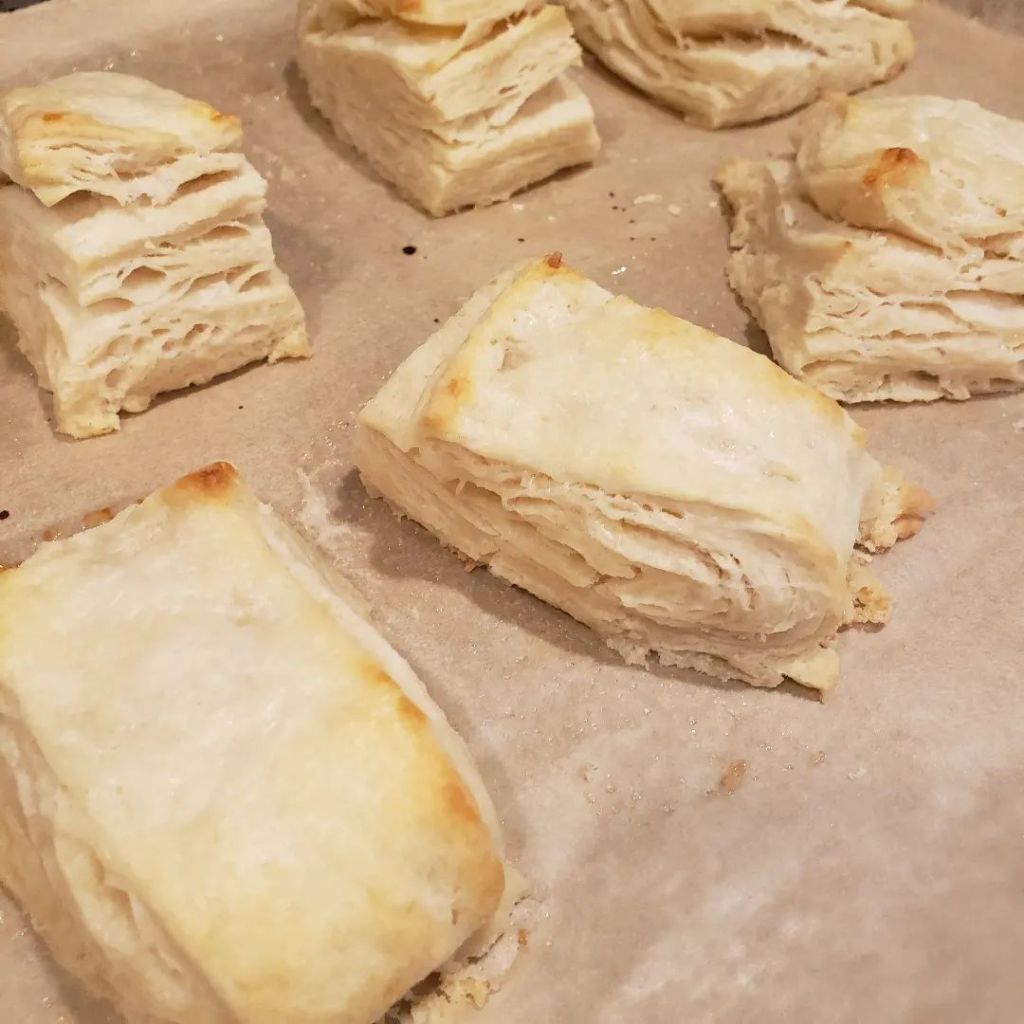
Ingredients
- 2 ½ cups All-Purpose Flour (300g) (plus more for dusting)
- 4 teaspoons Baking Powder (18g)
- 1 1/8 teaspoons salt (7g)
- 4 ½ Tablespoons Butter (60g)
- 4 ½ Tablespoons Cold Bacon Fat (60g)1
- 100mL Buttermilk2
- 100mL Whole Milk2
Tools
- Baking Sheet
- Bowl
- Fork
- Liquid Measuring Cup
- Bench scraper, spatula or other thin flat scraping instrument.
- Optional: Parchment Paper, Whisk, Kitchen Scale3, Rolling pin, fine mesh sieve4
Directions
Preparation
- Pre-heat your oven to 400 degrees F.
- Prepare a baking sheet with parchment paper or well greased with butter
- Measure out the butter and bacon fat and cut butter into small cubes. Place in the freezer to wait. Measure out the milks and place in the refrigerator to stay cold.
- Lightly flour your countertop, leaving a bit more flour in the center.
Assembly
- Combine the flour, Baking Powder, and salt in a large bowl. Stir or whisk until fully combined.
- Add the fats and using the fork quickly smash the pieces along the side of the bowl breaking them up and coating them in flour. You can also use your fingers to press the cubes of butter into disks. This should only take a minute or so in total.
- Add the milks to the bowl and use the fork to quickly stir until a rough shaggy dough has begun to form.
- Scrape the contents of the bowl onto your floured countertop into a pile
- Working quickly scrape the sides of the pile of dough pressing down and folding it over onto itself and flattening down. By the time you have done this several times the dough should have come together more or less into rectangle. Flatten this rectangle out into about an inch thick. (This is how we build in the layers)
Baking
- Using your scraper or a sharp knife, cut into eight rectangles (or circles if you want to be traditional).
- Place onto the prepared tray about an inch apart from each other, coat the tops of each one with additional buttermilk.
- Bake for 18-22 minutes or until golden brown on top and the inside measures 190 degrees on an instant read thermometer
Notes
- Cooking half a pound of bacon will usually result in enough bacon fat. If you cook the bacon in the oven it is easier to pour out the fat once it has cooled. You can also use more butter instead of bacon fat.
- You can change the proportions of these using either all of one or the other, so long as you have 200mL of liquid.
- I find a kitchen scale leaves me with less dishes and more precise results. If you don’t have one, lightly scoop the flour into the measuring cup and then scrape off the excess so that you do not compact the flour and over measure resulting in dry biscuits!
- I find that baking powder sometimes clumps, using a mesh strainer or tea steeper, helps to break this up so that the leavening agent is evenly dispersed.
 Rev. Drew Weseman